
Portfolio Website Design Templates: Complete SEO-Optimized Content
Introduction
A good portfolio website is really important. It is how you introduce yourself to people who might want to hire you like clients or employers.
If you do things like design develop websites take pictures or write, having a portfolio website is an idea. You can use templates to make a website without having to start from scratch.
Think of a template like a plan for your website. You do not have to spend a lot of time figuring out where to put your pictures, projects and contact information. You can use a template that already has a layout and then add your own stuff to it.
There are different kinds of templates you can use for your portfolio website. You can find templates for portfolios portfolios for creative people resumes and even templates, for designers who make products or user experiences.
In this guide you will learn about portfolio website templates. You will find out what they are, what kinds are available what parts your website should have, how to pick the design and how to make a template your own so it really shows who you are and what you can do as a portfolio website.
What Is a Portfolio Website Design Template?
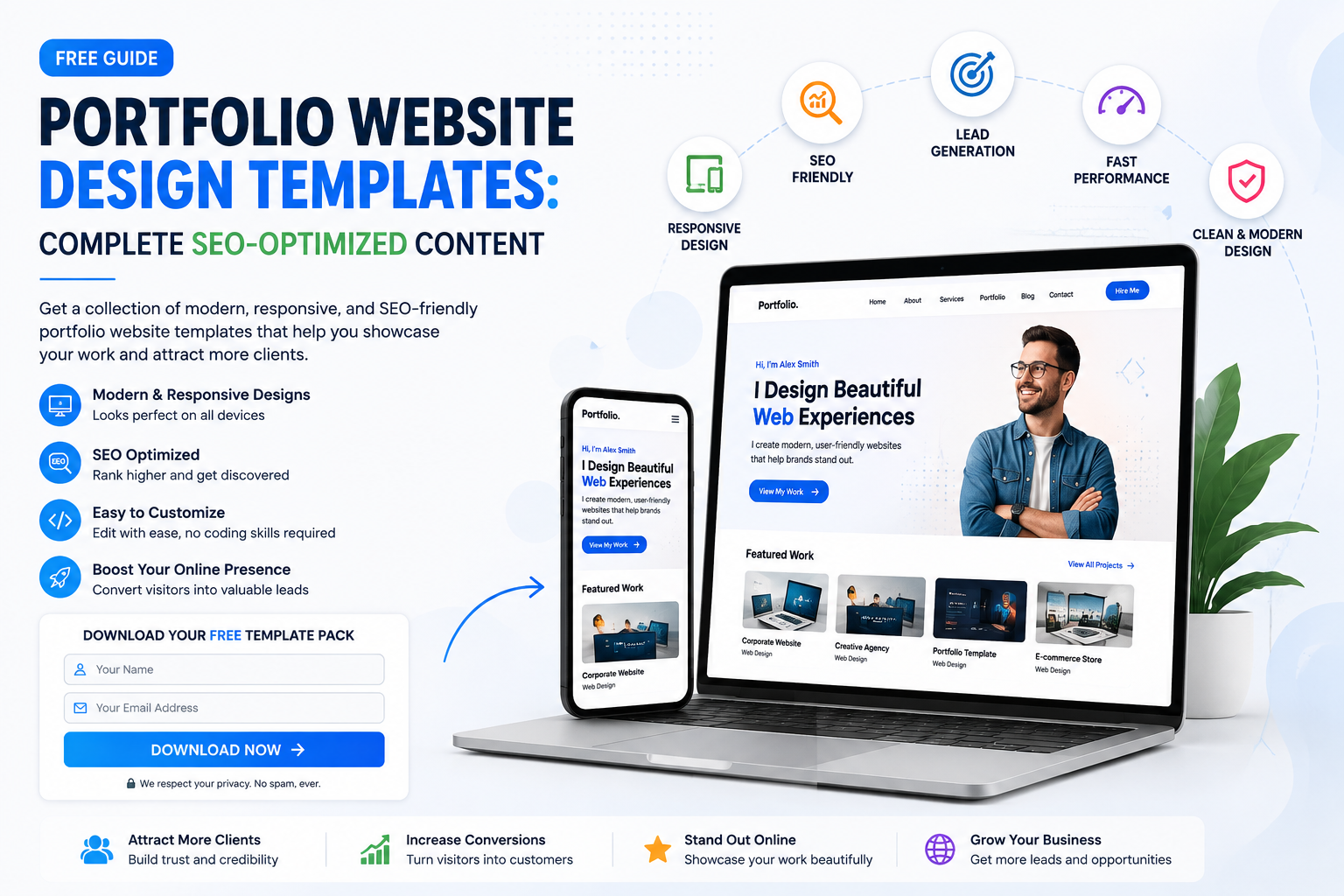
A portfolio website design template is like a made website that you can change to show your work and the things you are good at.
For example let us say you want to make a website for the work you do as a designer.
Normally you would have to make all these things from scratch:
* The homepage
* The menu that helps people find their way around your website
* A place to show all the projects you have worked on
* A section that tells people about you
* A page that lets people get in touch with you
* Buttons that people can click on
* The style of the letters and words on your website
* The colors you use on your website
* A version of your website that works well on phones
But with a portfolio template all these things are already set up for you.
You just have to put your work and information in place of the examples that are already there.
This is why portfolio templates are so helpful, for people who are just starting out.
You do not have to be a good website maker to make a portfolio website that looks really professional.
You can use a portfolio template. Make a great website for your graphic design work or any other kind of work you do.
Best Portfolio Website Design Templates for Different Professionals
Not every portfolio has to look the same.
A photographer might need images while a software developer might need project details and GitHub links. A UX designer might need in-depth case studies.
Here are some common types of portfolio website design templates you can think about.
Designer Portfolio Website Templates
Designer portfolio templates usually put a lot of focus on how things look.
They are a choice, for:
- Graphic designers
- UI designers
- UX designers
- Product designers
- Art directors
A simple project grid can help people see your design style fast.
Developer Portfolio Website Templates
A developer portfolio needs to make your technical skills easy to understand
sections include
- Programming skills
- Featured projects
- Technologies used
- GitHub profile
- Work experience
- Resume
- Contact information
A simple layout is often better, than adding many visual effects
Photographer Portfolio Website Templates
When you are a photographer your pictures should be what people notice first.
A good photography portfolio website template is one that gives you a lot of room to show off your high-quality pictures. At the time it should be easy for people to get around the site.
You can sort your photographs into groups, like:
- Weddings
- Fashion
- Travel
- Portraits
- Events
Commercial photography
This way people can see the different types of photography you do like photographer portfolio website templates that showcase your Commercial photography or your Portraits.
Freelancer Portfolio Website Templates
When people look at your portfolio website you want them to see the work you have done and the services you offer.
This is what freelancers use their portfolio website for.
- For example if you are a freelance writer you might want to put these things on your website:
- Writing samples
- Services
- What your clients say about you
- A section that tells people about you
- How much you charge for your work
- A form that people can use to get in touch with you
The main idea is to make things easy, for people who visit your website.
You want to show them what you do as a freelancer and make it easy for them to contact you.
This way people know what to expect from you and your services as a freelancer.
Creative Portfolio Website Templates
I think a Creative Portfolio Website Template is really helpful when you need to show off your work in a way.
This is because your work is about how things look.
Creative Portfolio Website Templates can be used by artists, illustrators, photographers, designers, video creators and creative agencies.
Some websites have a lot of Creative Portfolio Website Templates that you can use to make your website look really good.
These Creative Portfolio Website Templates have lots of layouts that you can change to fit your needs and they also have sections, for your portfolio things that people say about you, a blog and a contact form.
Personal Portfolio Website Templates
A Personal Portfolio Website is about you.
It tells people who you are.
A Personal Portfolio Website can have lots of things like your Biography and Skills and Education and Experience and Projects and Resume and Achievements and Contact information.
This kind of Personal Portfolio Website is really helpful for students and job seekers and freelancers and professionals who want to build a Personal Portfolio.
They want to show people what they can do and what they have done.
A Personal Portfolio Website is, like a way to say hello and tell people about your Personal Portfolio.
Best Portfolio Website Design Examples for Inspiration
Before choosing a template, it is smart to look at several portfolio website examples.
Why?
Because you may discover an idea that fits your work better than the first template you find.
Look at:
- How the homepage is organized
How projects are displayed
How colors are used
- How much text appears above the fold
- How the navigation works
- How the website looks on mobile
- How visitors are encouraged to contact the owner
Web design galleries can also provide useful inspiration. Awwwards, for example, features portfolio websites and related searches such as portfolio website design, web design portfolio websites, and professional portfolio websites.
The important thing is not to copy another person’s website.
Instead, ask yourself:
“What works well here, and how can I use the same idea in my own way?”
Portfolio Website Design Inspiration: Key Layout Ideas
A portfolio can use many different layouts.
Minimalist Portfolio Design
A minimalist portfolio uses fewer colors, fewer decorative elements, and plenty of white space.
This approach works particularly well when your projects should receive most of the attention.
Grid-Based Portfolio Layout
A grid shows a bunch of projects at once.
For example:
| Project | Category | Description |
|---|---|---|
| Project 1 | Branding | Logo and brand identity |
| Project 2 | UI Design | Mobile application interface |
| Project 3 | Web Design | E-commerce website |
| Project 4 | Illustration | Digital artwork |
This Grid-Based Portfolio Layout makes it easy for people who visit your website to look at your projects. The Grid-Based Portfolio Layout is really good, for this because it lets visitors see a lot of your work at the time.
One-Page Portfolio Website
A one-page portfolio puts important information on one long page.
A typical structure could be:
Hero → About → Skills → Projects → Experience → Testimonials → Contact
This can be a good choice if you have a small number of projects.
Portfolio Homepage Design Ideas That Attract Visitors
When people visit your website they usually see your homepage first.
This is the part of your portfolio that people look at initially.
You need to answer a simple questions for your visitors:
Who are you?
What do you do?
Why should someone care about your work?
For instance you can say something like:
“Hi I’m Rahul, a UI/UX designer who creates user-friendly digital experiences.”
Then you can add a button that says something like:
View My Work or Lets Work Together.
Do not put many long paragraphs on your homepage.
Your homepage should be simple and easy to understand.
Visitors should be able to understand what you do within a seconds.
You want people to know what your website is right away so keep your homepage simple and to the point.
Your homepage is like an impression so make it a good one.
People will look at your homepage. Decide if they want to learn more, about your work.
What Should a Professional Portfolio Website Include?
A professional portfolio website really does not need a lot of pages.
It just needs to have the information.
About Me Section and Personal Branding
Tell visitors who you’re as a professional portfolio website owner.
You should keep this part simple so people can understand you easily.
You need to mention a few things, such as:
- Your profession as a professional
- Your experience in your profession
- Your main skills that you are good, at
- Your interests that make you unique
- What type of work you want to do in the future
Your profile photo is also important because it can make your website feel more like it is really yours.
Portfolio Projects and Case Studies
This part is really important.
You should not just show a picture. Say Project 1. That does not tell people anything.
You need to explain some things about your Portfolio Projects and Case Studies.
What was the problem with Portfolio Projects and Case Studies that you were trying to solve?
What did you actually do to solve the problem with your Portfolio Projects and Case Studies?
What happened after you did that to your Portfolio Projects and Case Studies?
For example you could say something like this:
“The client wanted a way for customers to find products in their Portfolio Projects and Case Studies. I redesigned the navigation. Simplified the product page, in my Portfolio Projects and Case Studies.”
This way people can understand what you did with your Portfolio Projects and Case Studies and how you think about Portfolio Projects and Case Studies.
Skills, Services and Experience
Make your skills easy to scan.
For example:
- Web design
UI/UX design
- HTML
- CSS
- JavaScript
- SEO
- Content writing
If you offer services, explain what clients can hire you for.
Testimonials and Social Proof
If previous clients or employers have positive things to say about your work, display short testimonials.
Social proof can help new visitors feel more confident about working with you.
Contact and Call-to-Action Sections
Do not make people search for your contact information.
Add a clear CTA such as:
- Get in touch with us today
- We can build your website.
- Start your project today.
- You can request a consultation.
- We will give you a quote.
- You can talk to a web design expert.
- We can help you create your portfolio website today.
For your portfolio website design templates content I would recommend that you add a call to action such, as:
- You are ready to showcase your work.
- You can explore our portfolio website design templates.
- You can start building your website today.
Have a project in mind? Let’s talk.
Then provide your email, contact form, or relevant social profiles.
How to Choose the Best Portfolio Website Design Template
Choosing a template is not only about finding the most beautiful design.
The template should also fit your goals.
Responsive and Mobile-Friendly Portfolio Templates
Your website should work properly on:
- Smartphones
- Tablets
- Laptops
- Desktop computers
A beautiful desktop design is not useful if visitors cannot navigate it on a phone.
SEO Friendly Portfolio Website Templates
An SEO Friendly portfolio template should make it easy for search engines to understand the pages of your website.
Look for:
- Clear headings
- Descriptive page titles
- Good URL structure
- Image alt text
- Fast loading
- Mobile responsiveness
- Crawlable content
Do not choose a template only because it looks impressive.
A simple fast website can provide an experience, than a design overloaded with animations.
Fast Loading and Easy to Use Portfolio Templates
Website speed is important because people do not like to wait for a page to load.
Big images, animations and too many scripts can make a portfolio slow.
Make sure to compress your images and get rid of things that do not really add value.
Customizable Portfolio Website Templates
A template should let you change:
- Colors
Fonts
Images
Sections
Navigation
Buttons
Project layouts
- Branding
The more your template matches your brand the less you will have to edit.
Portfolio Website Templates for Different Platforms
You can find portfolio templates for different technologies and website platforms.
Here are some of the platforms and formats that are available:
| Platform/Format | Best For | Skill Level |
|---|---|---|
| HTML/CSS | Developers and people who are learning | Beginner to Skilled |
| WordPress | Bloggers, freelancers, and businesses | Beginner to Skilled |
| Figma | UI/UX designers and people who create prototypes | Beginner to Skilled |
| React | Web developers | Skilled |
| Bootstrap | Developers who want to use pre-built components | Skilled |
| Tailwind CSS | Developers who want flexible styling options | Intermediate to Skilled |
The templates that are available now usually include HTML, Bootstrap, Tailwind CSS, React, Figma and some other formats. These portfolio templates are really useful for people who want to make a website that showcases their work. Portfolio templates, like these can be very helpful.
HTML/CSS Portfolio Website Templates
HTML and CSS templates are useful if you want direct control over your website’s code.
They are also a good learning option for students who want to understand how websites are built.
WordPress Portfolio Website Templates
WordPress templates can be a good choice if you want to update your portfolio without editing code every time.
You can add projects, blog posts, images, and other content through the WordPress dashboard.
Figma Portfolio Website Templates
Figma portfolio templates are especially useful for designers.
You can change the layout, colors, typography, and components before turning the design into a working website.
Figma-based portfolio resources include personal portfolio templates, product designer portfolios, UX portfolio layouts, illustration portfolios, and portfolio website designs.
Free Portfolio Website Design Templates vs Premium Templates
Should you choose a free template or pay for one?
There is no single answer.
| Feature | Free Templates | Premium Templates |
|---|---|---|
| Cost | Usually free | Paid |
| Design Options | Often limited | Usually more extensive |
| Customization | Varies | Usually greater |
| Support | Limited or community-based | Often included |
| Features | Basic to moderate | Often more advanced |
| Best For | Students and beginners | Professionals and businesses |
Free templates can be an excellent starting point.
Premium templates can make sense when you need advanced features, better support, or a more specialized design.
Free Portfolio Templates: The Good And The Bad
The good things about free portfolio templates are:
- They do not cost you any money to start with
- They are great for people who are just starting out
- You can try out things without worrying about the cost
- Free portfolio templates are really useful for students who need to make a portfolio
The bad things about free portfolio templates are:
- Could have less features, than paid options
- Some designs might look the same as others
- Help might not be available when needed
Premium Portfolio Templates: The Good And The Bad
The things about Premium Portfolio Templates are:
- They have a lot of design options
- You can customize them a lot
- They usually have good instructions
- Sometimes they even include help from people
The bad things about Premium Portfolio Templates are:
- You have to pay for them
- Some of the things they can do are not really needed
- You still have to put in the work to make the content good
Remember: just because you pay for a Premium Portfolio Template does not mean it will make your portfolio better.
Premium Portfolio Templates are not the important thing. What really matters is the work you have done on your projects and how you present them. Your projects and how you present them matter more, than Premium Portfolio Templates.
How to Customize a Portfolio Website Design Template
Once you pick a template do not just change the demo name to your name. Go live.
Make it your own.
Step 1: Define Your Goal
figure out why you need the portfolio.
Are you trying to:
- Get a job?
- Find freelance clients?
- Attract design projects?
- Build your brand?
- Show your coding skills?
Your goal should shape your design.
Step 2: Replace the Demo Content
Take out all the sample content.
Put in your own:
- Name
- Photo
- Projects
- Skills
- Experience
- Testimonials
- Contact details
Step 3: Add Your Best Projects
Do not include every project you have ever made.
Pick your work.
Three great projects are often than twenty okay ones.
Step 4: Improve Your Project Descriptions
For each project tell:
Goal → Your role → Process → Result
This turns a project gallery into a helpful case study.
Step 5: Test the Website
Before you launch look at the portfolio on screen sizes.
Also check:
- Navigation
Contact forms
Buttons
- Images
- Links
Page speed
- Mobile layout
Step 6: Add Basic SEO
Use your keyword in a natural way.
For example if your page is, about portfolio website design templates you can use phrases like:
- portfolio website templates
- personal portfolio website
- professional portfolio website
- creative portfolio
- portfolio web design
- portfolio website inspiration
- web design portfolio
- responsive portfolio template
- minimalist portfolio design
- portfolio website examples
Do not force the keyword.
Write for people first.
Portfolio Website Design Mistakes to Avoid
Even a good template can turn into a portfolio if you don’t use it right.
Avoid these mistakes:
1. Many Animations
Animations can look nice but too many can make it hard to move around the site.
2. Much Text
Your portfolio should be easy to look through.
Use paragraphs, headings, bullet points and visual examples.
3. Poor-Quality Images
If your portfolio is about visuals blurry images can make your work look unprofessional.
4. No Clear Call to Action
People who visit should know what to do
Give them an action like:
Contact Me
View Projects
or
Download Resume
5. Ignoring Mobile Users
Always make sure your portfolio looks good on a phone.
6. Copying Another Portfolio
Look at websites, for ideas but build your own style.
7. Using a Template Without Changing It
A template is the beginning.
Your content, your projects, your personality and your branding are what make the portfolio special.
Portfolio Website Design Templates: Features Checklist
Before choosing a template use this checklist:
| Feature | Why It Matters |
|---|---|
| Responsive Design | Works across different devices |
| Clean Navigation | Helps visitors find information |
| Portfolio Gallery | Displays your projects |
| Case Study Layout | Explains your work |
| Contact Section | Helps visitors reach you |
| Fast Loading | Improves user experience |
| SEO-Friendly Structure | Helps search engines understand the website |
| Customizable Design | Lets you match your personal brand |
| Accessibility | Makes the site easier for more people to use |
| Social Links | Connects visitors to your professional profiles |
How to Make Portfolio Content More Visible in Generative AI Search
There is no trick that will make your page show up in search results made by artificial intelligence.
A better way to do this is to create content that’s useful original and easy to follow and that clearly answers the questions that people have.
Google says that you should create content for people not for computers. You should organize your content with headings and sections and add new and useful information. Do not just make content that does not say anything new.
When it comes to portfolio content make sure your answers are easy to understand.
For example:
Question: What is a portfolio website design template?
Answer: A portfolio website design template is a -made layout, for a website that helps professionals show their work, skills, experience and contact information without having to design every page from scratch.
This question-and-answer format makes it easy for people and search systems to understand information.
You can also do these things:
- Use headings that describe what you are talking about
- Answer questions
- Give examples
- Use tables to compare things
- Add your advice
- Include pictures that’re relevant
- Keep your paragraphs short
- Do not try to trick the system by repeating keywords
- Show that you have experience when you can
Google says that content that is well-organized and puts people first is the best. They also say that useful pictures and videos can help you show up in search features.
Portfolio Website Design Templates FAQs
What is the best portfolio website design template for my needs?
The best portfolio website design template is the one that fits my profession shows off my work works great on my phone loads fast and lets me make it my own.
Where can I find free portfolio website design templates to get started?
I can find free portfolio website design templates on template libraries design communities and open-source website resources. Some of these collections have HTML, Bootstrap, Tailwind CSS React and portfolio- templates that I can use.
What should I include on my portfolio website to make it effective?
My portfolio website should have an introduction, an about section, my projects or case studies my skills my experience and testimonials if they are relevant. I should also have a contact section so people can get in touch with me.
Are portfolio website templates good for search engines like Google?
Some portfolio website templates are good for search engines. Not all of them. I need to check if the template works well on devices loads quickly uses the right heading structure and lets me add descriptive metadata to help search engines find my portfolio website.
How do I pick a portfolio template that’s right for my profession?
I should think about who my audience’s what kind of work I want to show them. For example if I am a photographer I need a template that shows off my photos well. If I am a developer I need a template that lets me share details about my projects the technologies I use and links to my projects or code
Can I make changes to portfolio website templates to fit my needs?
Yes I can make changes to portfolio website templates. I can change the content, images, colors, fonts, layouts and branding to make it my own. How much I can change depends on the platform and the template I choose.
What is the difference between a personal portfolio website and a professional portfolio website?
A personal portfolio website is more about me my skills, my interests and my experience. A professional portfolio website is more, about my work the results I have achieved the services I offer my clients and my career experience.
How much will a portfolio website template cost me?
Portfolio website templates can be free or they can cost money. The cost depends on what I need and what I’m willing to pay for. I should choose a template that fits my budget and has the features I need for my portfolio website.
Final Thoughts
Picking the right portfolio website design templates is a start.. The template is not what makes your portfolio website good.
Your projects and your story and your skills and how you present yourself and your personality are what people remember about your portfolio website.
So what do you do? Start with an clean design. Put your projects on the website. Explain what you did on each project so people understand. Make sure the website loads fast and works on phones and tablets.. Make it easy for people to get in touch with you.
The important thing is do not make your portfolio website too complicated just to make it look fancy.
A simple portfolio website that clearly shows what you can do is better, than a website that confuses people. Your portfolio website should be simple and easy to use like your portfolio website is a portfolio that shows people what you can do.