
E Commerce Website Design Template: Complete Guide to Building a Professional Online Store
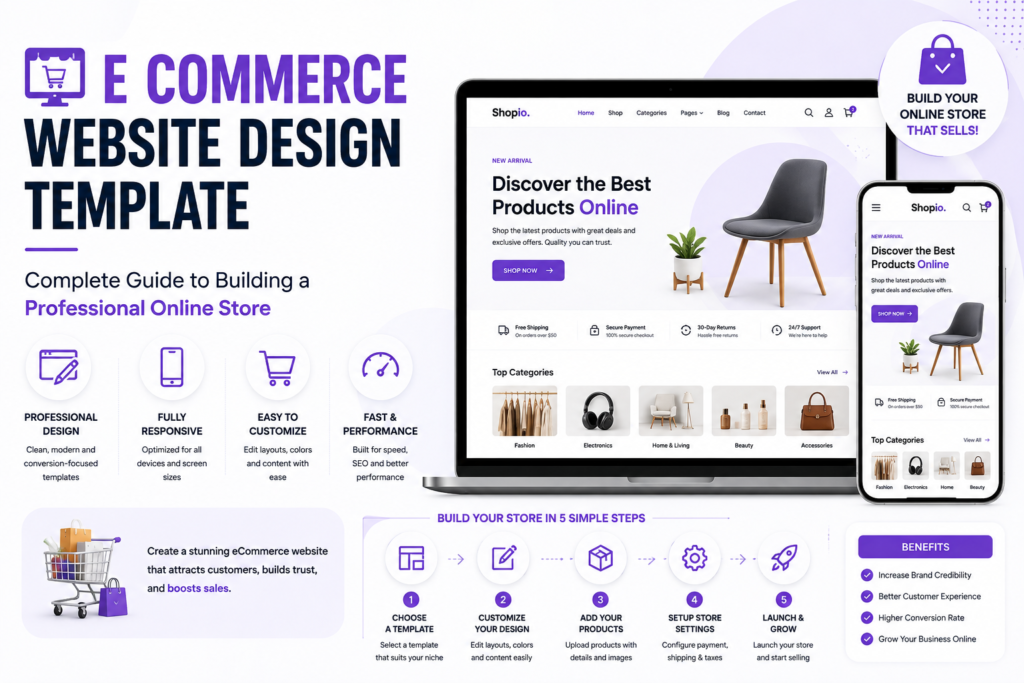
When you plan to sell products on the web, one of the first things that you will require is an ecommerce website design template. Rather than build the website from scratch, you can go for a pre-designed template which contains all the necessary pages that an online store should have.
It can be considered to be a ready-made house where you only need to furnish the property with your own products, pictures, and color scheme.
Whether you plan to start an apparel, electronics, beauty, or crafts business, selecting an appropriate ecommerce website template can make your life easier as it can save your time, cut down development expenses, and allow you to start operating much sooner.
In this tutorial, we will talk about what an ecommerce website design template is, its importance, the way to select an appropriate template, and some features that may help increase the number of sales.
What is an E Commerce Website Design Template?
When selling items on the Internet, the very first thing that will be needed is an e-commerce website design template. Rather than building an E-commerce website design template is basically a website template built especially for online business sites. It has already designed pages such as those for navigation, shopping carts, products, checkout process, and many more.
By using such a template, rather than hiring a web designer to design all the pages from scratch, businesses can simply customize the template by adding their logo, products, images, color schemes, and contents.
These days, the use of templates is common due to many reasons.
Example
Think about opening an online shoe shop.
Rather than taking months to design the site yourself, you can select a professional online store website template, add your pictures, write descriptions, set prices, and start selling your goods in just a few days.
Such is the benefit of using an appropriate ecommerce template.
Why Choosing the Right Online Store Website Template Matters
The website is the first point of contact that most people have when entering into contact with your business.
If the website is outdated or takes too long to load, chances are that potential customers will leave the website without buying anything.
This is where a modern website template for an online store comes in handy because it creates a pleasant experience for shoppers who wish to buy something.
Advantages of Using a Professional E-commerce Website Template
(i) Fast website launch
(ii) Professional look
(iii) Enhanced customer experience
(iv) Responsive design
(v) Faster website loading
(vi) Easy to customize
(vii) Search engine friendly
(viii)Secure checkout pages
(ix) Conversion optimization
No matter what your organization is big or small, choosing a proper template is definitely worth the cost.
What Makes a Great Ecommerce Website Design?
Good ecommerce website design is not merely about having colorful images.
It revolves around making the shopping experience for the customer easy and convenient.
A well-designed ecommerce website design takes the visitor from the home page to the checkout page seamlessly.
Some important objectives of web design for ecommerce sites are as follows:
(i) Ensuring that products are easily accessible
(ii) Generating customer trust
(iii) Minimizing distractions
(iv) Streamlining the purchasing process
(v) Encouraging repeat business
The easier the website is to use, the greater the chances that visitors will become buyers.
Essential Features of a Responsive Ecommerce Template
In today’s world, consumers do their shopping via smartphones and tablets.
That is why the layout of any good modern ecommerce template must automatically adapt to screen size variations.
It doesn’t matter whether your visitors access your website through a desktop PC or mobile device – the process of browsing must be comfortable for them.
Main Components of a Responsive Ecommerce Theme
(i) Mobile-friendly design
(ii) Quick page load
(iii) Product grid system
(v) Responsive navigation bar
(vi) Optimized product images
(vii) Simple checkout process
(viii) User-friendly buttons
(ix) Mobile search feature
The fact that Google favors mobile-friendly sites makes responsive templates advantageous for SEO purposes.
How an Online Shopping Website Increases Business Growth
Customers can shop for products on an e-commerce site at any time from any location.
In contrast with a brick-and-mortar store, which is open during fixed business hours, an online store functions 24/7.
It implies that you can generate revenues even when you sleep.
Some other benefits are:
(i) Access to customers globally
(ii) Reduced overhead costs
(iii) Improved stock management
(v) Online payment methods
(vi) Customer rating
(vii) Marketing via SEO and social networking
(viii)Order tracking system
Since people increasingly use the internet to purchase products, there is a better chance for companies to expand if they have their professional ecommerce websites.
Ecommerce Web Design Best Practices
Designing an appealing website is essential; however, designing a website that turns visitors into paying customers is far more important. There are several basic rules in good ecommerce web design.
Keep Navigation Simple
Products must be easily found in a matter of a few clicks.
Too many categories in a navigation menu may be confusing.
Use High-Quality Product Images
Good quality images build trust and help people understand exactly what they buy.
Use several images of a product from various angles when possible.
Write Product Descriptions
Instead of listing all features, try to explain the problem that the product solves for the customer.
Use simple language understandable to everyone.
Keep Checkout Process Simple
Complicated checkout process results in cart abandonment.
Ask for necessary information only and offer various payment methods.
Establish Trust Provide:
(i) Customer reviews
(ii) Security badges for payments
(iii) Returns policy
(iv) Contact details
(v) Shipping details
Trust is one of the key elements that determine purchases online.
Designing the Perfect Ecommerce Store Layout
A proper layout for an ecommerce website enables the visitor to easily find the product he is searching for.
Each page must have an objective.
Homepage
Your homepage must have:
(i) Featured products
(ii) Categories
(iii) Promotional banners
(iv) Search box
(v) Top selling products
(vi) Testimonials from customers
Category Pages
Category pages help group the products under categories like:
(i) Clothing
(ii) Electronics
(iii) Furniture
(iv) Beauty products
Product Pages
A product page must have:
(i) Images of the product
(ii) Name of the product
(iii) Price
(iv) Description of the product
(v) Specifications
(vi) Reviews by customers
(vii) “Add to cart” button
(viii) Delivery details
Checkout Page
Ensure that the checkout page is simple, secure and distraction free.
Why Ecommerce UI Design Matters
Ecommerce UI design (User Interface Design) deals with the visual aspect of your website and how users interact with it.
An elegant interface is fun to shop from.
A cluttered interface results in high bounce rates.
Effective UI design requires:
(i) Clean typography
(ii) Coherent colors
(iii) Intuitive buttons
(iv) Simple navigation
(v) Organized products categories
(vi) Pretty product cards
(vii) Easy-to-use search feature
Keep in mind that users should not have to guess their next action.
Everything on your website should lead them to buy.
Website Builder Templates Make Creating an Online Store Easy
Everyone does not know how to code.
This is when website builder templates come into play.
Website builders such as Shopify, WooCommerce, Wix, Hostinger Website Builder, and Webflow provide users with templates to create professional ecommerce sites by dragging and dropping.
The advantages are:
(i) No coding knowledge is necessary
(ii) Quick creation of websites
(iii) Customization
(iv) Built-in SEO features
(v) Hosting
(vi) Mobile-friendly designs
(vii) Payment gateway connection
(VIII) Automatic updates
Product Page Design: The Most Important Page on Your Ecommerce Website
Design of the product page determines the success of a sale.
Despite the customers’ appreciation of your homepage, they will not purchase from you if your product page does not contain all the necessary information.
The best-converting product page should have:
(i) Good quality pictures of the product
(ii) Product title
(iii) Detailed yet concise description
(iv) Available sizes or colors
(v) Stock status
(vi) Customer ratings and reviews
(vii) Information about shipping
(viii) Return policy
(ix) FAQ section
(x) “Add to Cart” button
(xi) “Buy Now” button
Best Practices for Product Page Design Keep the description simple and benefit-oriented.
Emphasize key product features using bullet points.
Display trust and security seals.
Provide customer reviews to establish credibility.
Feature additional recommended products.
Shopping Cart Design: Make Buying Easy for Your Customers
Can you imagine yourself going on an online shopping site, selecting your items, and ending up confused about how to checkout? It is very likely that you will abandon the website.
That is why the shopping cart is one of the key factors in designing an e-commerce website. The good news is that the shopping cart allows your customer to view his/her products and check out conveniently.
It not only makes shopping easier for your customers but also minimizes cart abandonment.
Essential Features of a Good Shopping Cart Design
Your shopping cart must contain:
(i) Product images for easy recognition
(ii) Name and short description of the product
(iii) Price and Quantity field
(iv) An option to remove or edit the item
(v) Estimated cost of shipping
(vi) Discount codes/coupon field
(vii) Order total
(viii) Button to check out
(ix) Option to continue shopping
Best Practices for Shopping Cart Design
(i) Do not make the design too complicated.
(ii) Make sure all the expenses are visible.
(iii) Enable easy editing of the cart.
(iv) Place trust badges on your website.
(v) Provide guest checkout.
(vi) Save the items in the cart for future visits.
A good user experience during cart process makes customers more willing to buy something from your store.
Why Every Mobile-Friendly Ecommerce Website Wins More Customers
Did you know that today’s online customers use their smartphones to look for and purchase products?
This is the reason why all responsive e-commerce websites adapt themselves for every possible screen size including mobile phones, tablets, laptops, and desktops.
Responsive websites will change their layout, images, buttons, and texts according to the screen size so that users will not be required to use zooming or scrolling.
Google uses mobile-first indexing so that Google will take into consideration mobile versions of websites when determining the search ranking.
Benefits of a Mobile-Friendly Ecommerce Website
(i) User Experience is Better
(ii) The Website Loads Faster
(iii) Improves Google Rankings
(iv) Increases Online Sales
(v) Bounce Rate is Low
(vi) Website Navigation is Easy
(vii) Customers Satisfied with the Website
Tips to Create a Mobile-Friendly Ecommerce Website
(i) Responsive Design
(ii) Buttons Big Enough to Tap on
(iii) Images Compressed for Quick Loading
(iv) Simple Menus
(v) Pop-Ups Should Not be There
(vi) Website Tested on Various Devices
“If consumers feel comfortable browsing for items on their phones, then they will be more likely to turn into loyal consumers.”
Build an SEO-Friendly Ecommerce Website to Get More Organic Traffic
“If you have a pretty website but no one knows about it.”
SEO-optimized websites make it easier for search engines such as Google to crawl and index your website and rank your pages higher up on Google Search.
If anyone is searching for something that your business sells, then having an SEO-optimized website means you will appear on the first page of Google.
Features of an SEO-Friendly Ecommerce Website
(i) Quick page loading speed
(ii) Mobile-friendly design
(iii) Simple URL structure
(iv) Product page optimization
(v) Meta titles & description
(vi) Optimized images
(vii) Internal links
(viii) Schema markup
(ix) HTTPS secure website
Why SEO Matters for Ecommerce
SEO allows you to:
(i) Increase traffic organically
(ii) Cut advertising budgets
(iii) Get in front of people looking for your products
(iv) Improve brand visibility
(v) Make sales
This SEO friendly template for an ecommerce site will give you a great start in ranking better and receiving quality traffic.
Custom Ecommerce Website vs Website Templates
There are many business owners who want to know whether they should opt for a pre-designed ecommerce template or have a custom ecommerce website.
It all depends on your needs and your budget.
What is a Custom Ecommerce Website?
A custom ecommerce website is an ecommerce website that is created specifically for your business needs.
Benefits of a Custom Ecommerce Website
(i)Distinct brand identity
(ii)Endless customization
(iii)Enhanced scalability
(iv)Improved functionalities
(v)Tailored user experience
Benefits of Ecommerce Website Templates
(i) Cost-effective
(ii) Quick launch
(iii) User-friendly
(iv) Easier maintenance
(v) Ready-to-use features
(vi) No coding involved
In the case of startups and small businesses, an e-commerce website template design can be the right way to go. When your business develops further, you can always opt for something more customized later on.
Why WooCommerce Templates Are Perfect for WordPress Users
In case your site uses the WordPress platform, a WooCommerce template is an excellent way to build an elegant online shop.
WooCommerce is a robust ecommerce solution which turns any WordPress site into a full-fledged shopping platform.
Benefits of WooCommerce Templates
(i) Simple to install
(ii) Many free and paid themes
(iii) Great customization opportunities
(iv) Search engine optimized layout
(v) Payment integration
(vi) Product management tools
(vii)Lots of plugins
WooCommerce templates suit those who need a full control over the online shop without huge development expenses.
Shopify Themes: Launch an Online Store Without Coding
If you want an easy way to start your own ecommerce business, then using a Shopify theme would be perfect.
With Shopify, you will get professionally designed themes, which can help you start your ecommerce business without having to write even a line of code.
Advantages of Shopify Themes
(i) Professional Design
(ii) Mobile Responsiveness
(iii) Hosted Automatically
(iv) Secure Checkout Process
(v) Application Integrations
(vi) Quick Loading
(vii) Customizable
This particular platform is very famous among new users because it allows them to do everything related to their ecommerce business on one platform only.
Webflow Ecommerce Templates for Modern Businesses
For those companies that desire more creativity, a Webflow ecommerce template will serve as the best combination of design and functionality.
Different from all other website builders, Webflow makes it possible to design unique websites, taking care of all aspects of managing products, payment and order processing.
Why Choose Webflow Ecommerce Templates?
- Modern responsive design
- Animations
- Visual editor
- Search engine optimization
- Content Management System
- High speed
- Versatile layouts
If you need a fast and premium-looking website for your products, then Webflow will suit you perfectly well.
Design an Ecommerce Homepage That Creates a Great First Impression
An ecommerce homepage is the equivalent of a physical store’s front door.
It takes just a few seconds for people to make up their mind whether to stay or go.
An effective homepage must be able to say right away who you are, what you offer, and what makes your brand the better choice.
Ecommerce Homepage Essentials
(i) Distinct logo
(ii) Simple navigation menu
(iii) Hero banner with a call-to-action
(iv) Featured products
(v) Bestselling products
(vi) Categories
(vii) Customer testimonials
(viii) Special offers
(ix) Newsletter subscription form
(x) Footer with key links
Keep your homepage organized, visually pleasing, and user-friendly.
Build a Conversion-Focused Website That Turns Visitors into Customers
Luring people to the site is not the whole story.
Conversion is what you have to do once the people have come to your site.
A conversion website is one which motivates visitors to act, from buying something to signing up for the newsletter or making an inquiry.
Ways to Enhance Your Website Conversions
(i) Call-to-action buttons
(ii) Quality product pictures
(iii) Trust icons
(iv) Customer testimonials
(v) Time-limited offers
(vi) Easily navigable checkout
(vii) Live chat
(viii) Return policy
(ix) Fast page loading
Even small changes in your website design will help to increase sales dramatically.
Ecommerce UX Design: Create an Enjoyable Shopping Experience
While UI deals with the look of the website, ecommerce UX design is all about the customer’s feelings while he or she is using the site.
A great user experience eliminates all frustration and creates an easy, pleasant, and efficient process of shopping.
Features of Great Ecommerce UX Design
(i) Ease of navigation
(ii) Fast page load
(iii) Consistency
(iv) Searchability
(v) Filters
(vi) Product information
(vii) Optimization for mobile devices
(viii) Accessibility
The customers will be more likely to stay on your website, explore its product range, and make purchases if they like browsing through it.
Online Store Design Tips for Long-Term Business Success
The web design of your online store needs to serve more purposes than just looking attractive.
It should contribute to the overall user shopping experience and make customers feel confident when browsing through the store.
Key Aspects of Online Store Design
(i) Maintain consistent branding on all site pages.
(ii) Use quality product photography.
(iii) Select legible fonts and colors.
(iv) Arrange products into categories.
(v) Add search and filtering functionality.
(vi) Show customer reviews and ratings.
(vii) Feature safe and secure payment options.
(viii) Ensure mobile optimization of all pages.
(ix) Prioritize website performance.
(x) Continually test your website design.
Please keep in mind that the most effective template for an e-commerce website is the one that is professional in terms of both design and usability, and which performs well from the SEO point of view.
Best Practices for Choosing the Right E Commerce Website Design Template
Selecting an appropriate ecommerce website design template is arguably one of the most crucial decisions that can be made for any online venture. An appropriate template will not only increase the appeal of a website but also increase user experience, improve page ranking in Google and encourage visitors to become customers.
Before choosing an appropriate template, ask yourself the following questions:
- Is it mobile friendly?
- Is it fast?
- Is it SEO friendly?
- Am I able to customize it to meet my growing business needs?
- Does it have secure payment gateways?
- Is it customer friendly?
The answers to these questions should help you select an appropriate template for your website.
Ecommerce Website Design Checklist
Follow this checklist before you launch your ecommerce site.
| Feature | Why It Matters |
|---|---|
| Responsive Design | Works well on all devices. |
| Loading Speed | Good for users and SEO. |
| SSL Certificate | Secures customers’ information. |
| Payment Gateway | Builds trust with customers. |
| Search Feature | Makes it easy for visitors to find products quickly. |
| Filter Options | Helps shoppers find the right products faster. |
| Shopping Cart | Makes the shopping experience simple and convenient. |
| Checkout Process | Reduces cart abandonment and improves conversions. |
| SEO-Friendly URLs | Improves Google rankings and search visibility. |
| Contact Us Page | Builds credibility and customer confidence. |
| Customer Reviews | Builds trust through social proof. |
| Links to Social Networks | Increases brand exposure and customer engagement. |
Common Mistakes to Avoid When Designing an Ecommerce Website
Even the most successful companies will lose customers due to bad website design.
This is what you should not do:
1. Slow Loading Website Pages
Customers will expect website pages to be loaded within just a few seconds. The pages that are slow will result in increased bounce rate and fewer conversions.
2. Bad Website Navigation
Visitors will need to get the products in no time. A complex menu will confuse people.
3. Poor Quality Product Images
If the product pictures are blurry and of low quality, they will not look professional.
4. Difficult Checkout Process
The checkout process might require too many data to be provided by a customer and result in abandoned shopping carts.
5. Ignoring Mobile Visitors
Half of the online shoppers browse through sites on mobiles. Your site should be mobile-friendly and convenient.
6. Ineffective Call-to-Action Buttons
These buttons should be easy to spot and effective.
Practical Tips to Improve Your Ecommerce Website
You do not necessarily have to go through a redesign process to boost your online store.
Improve Website Speed
(i) Compress large images.
(ii) Delete unused plugins.
(iii) Have a good hosting company.
(iv) Turn on browser caching.
Build Customer Trust
(i) Show customer testimonials.
(ii) Have secure payment icons.
(iii) Provide detailed shipping information.
(iv) Add return and refund policies.
Improve User Experience
(i) Maintain clean page layouts.
(ii) Utilize simple navigation bars.
(iii) Simplify the process of navigating through product categories.
(iv) Add a search bar with filters.
Increase Conversions
(i) Highlight your top products.
(ii) Add time-limited offers.
(iii) Show messages regarding free shipping.
(iv) Show related products on your product pages.
How an Ecommerce Website Design Template Helps Your Business Grow
A well-designed ecommerce website is capable of doing much more than showcasing products.
It helps the business to:
(i) Bring more traffic via SEO.
(ii) Generate trust with professional design.
(iii) Improve customer satisfaction.
(iv) Enhance conversion rates.
(v) Generate more repeat customers.
(vi) Raise brand awareness.
(vii)Save on development time and money.
Whatever stage you are at, from creating your very first online store to redesigning an already existing one, spending on an appropriate e-commerce website design template will prove beneficial in the long run.
Featured Snippet: What Is an E Commerce Website Design Template?
E-commerce website design templates are pre-designed layouts that are created especially for online stores. The design template will incorporate vital components such as product pages, shopping cart page, checkout page, and responsive design among others and thus, help create an online store website easily.
Featured Snippet: How Do You Choose the Best Ecommerce Website Template?
For selecting the most appropriate ecommerce website template:
(i) Consider getting a mobile friendly design.
(ii) Consider getting an SEO friendly template.
(iii) Consider checking page loading speed.
(iv) Consider getting customizable template.
(v) Consider ensuring the secure payment integration.
(vi) Consider having responsive design.
(vii) Consider having a template suitable for your brand.
Conclusion
An effective way to set up an online shop is to select the correct e commerce website design template.
A professional website template will enable you to design a visually appealing, quick, and convenient shopping environment that will make users loyal customers.
Keep in mind responsive design, SEO, user experience, and good navigation. Add good quality product photos, product descriptions, and simple purchase process to get a perfect online shop.
Keep in mind that your site is not just a virtual shop—it is one of the best marketing tools you have. By investing in an ecommerce website today, you will be able to benefit from it tomorrow.
Frequently Asked Questions (FAQ)
What is an e commerce website design template?
An e-commerce site design template is a design layout to create an online shop. It provides necessary pages such as home page, product page, shopping cart, and check out page, thus making it simple to start an ecommerce business.
Why should I use an ecommerce website template instead of building a website from scratch?
The templates are quick to configure, cost-effective, and have most of the features that would be required for the online shop. Templates suit the beginners and small enterprises.
Are ecommerce website templates SEO-friendly?
Yes, most modern e-commerce templates are created with SEO in mind through the use of elements like responsiveness, proper coding, optimized URLs, and fast loading times, among others.
Which platform offers the best ecommerce website templates?
Shopify, WooCommerce, Webflow, Wix, BigCommerce, and Hostinger Website Builder are some popular websites for creating your own business. You need to decide based on your budget and expertise.
Can I customize an ecommerce website template?
Certainly. Most templates can be customized using colors, fonts, layouts, images, logos, and content based on the branding of the company.
What features should every ecommerce website have?
An ecommerce website must have:
(i) Responsive design
(ii) Catalog
(iii) Shopping cart
(iv) Checkout process
(v) Integrated payment gateway
(vi) Product search
(vii) Customer reviews
(viii) Contact page
(ix) SSL certification
(x) SEO-friendly structure
How important is mobile-friendly design for an online store?
It is very crucial. Consumers do their shopping and purchasing on smartphones. Having an optimized site for mobile devices can help improve the user experience and SEO.
How can I improve conversions on my ecommerce website?
(i) Conversions can be enhanced through:
(ii) High quality product images
(iii) Clear product descriptions
(iv) Making the check-out procedure easy
(v) Showing customer reviews
(vi) Providing safe payment options
(vii) Website speed improvement
(viii) Use of clear call-to-action buttons
What is the difference between UI and UX in ecommerce design?
UI (User Interface) refers to the design of your site, including things like buttons, colors, and design elements.
UX (User Experience) refers to ease of use and satisfaction with using the website.
Both play an important role in creating a good ecommerce website.
Is a custom ecommerce website better than a template?
A custom-built website allows for greater flexibility and uniqueness, but costs more money and takes more time than an e-commerce website template to build. The ecommerce website template is one of the most economical options for small start-up businesses.
Final Key Takeaways
- Select a user-friendly and SEO-optimized online store website design.
- Pay attention to user experience and ease of navigation.
- Optimize the website in terms of speed and mobile devices.
- Gain customer trust by offering secure payments and customers’ reviews.
- Include well-designed product pages with calls to action.
- Test and optimize the website regularly.
With all of these considerations, you will develop an online store that is both visually appealing and optimized for the search engines, offering your visitors a great shopping experience.
1 Comment
[…] E-commerce website […]